Integrating Gender Training Policy: A
Gateway
Towards Future Development
Nadia Aziz[1]&
Mona El Kady[2]
ï؟½Abstract:
ï؟½ï؟½ï؟½ï؟½ï؟½ï؟½ï؟½ï؟½ï؟½ï؟½ï؟½ The concept of gender issues and
related subjects are relatively new, particularly in the underdeveloped
countries worldwide. The relevant terminologies, such as; gender equality,
gender sensitivity, gender mainstreaming, empowerment, integration,
participation and many others, have no clear common understanding among gender
analysts, specialists, expertsï؟½.etc working in such important field. Abusing
attitudes towards farm labor women are indeed due to misunderstanding or even
ignorance about human social relations, culture, traditions, wrong habits and
attitudes, low standards of living, poor environmental conditions and many
other factors. Therefore, to change all these discouraging and inhibiting
factors to the sustainable development nationwide, it needs long-term strategy
to change the human attitudes and the wrong beliefs.
ï؟½ï؟½ï؟½ï؟½ï؟½ï؟½ Politics, available technologies and decision making,
form the real national power and the driving force to steer the wheel towards
women enforcement in the society specially in less democratic systems where
women may not be able to express themselves explicitly to the public media
freely. Therefore, the blessing of such trilateral power driving force is
essential to make social organizations efforts, effective and efficient in the
field of gender. Accordingly, the initial focus should be directed to convince
top management planners politicians and decision makers with the importance of
gender mainstreaming in the development process. Meantime, in depth analysis by
sociologists and gender experts must be made to understand clearly the actual
obstacles and objections to accept the discussion of social gender affairs and
problems within the rural communities, in order to mediate the rejection to change.
The end result should be a) gaining support from the official authorities, and
b) developing a suitable social environment ready to accept new ideas and
concepts, concerning gender affairs. Disciplined efforts are most needed as we apply
well-organized and designed tools appropriate to poor women communities in less
developing countries, at the regional level. This objective is aiming to
establish a regional gender-training center (RGTC) to offer non-traditional
training programmes to gender specialists of the region. Therefore, our role
and responsibility at this stage is to support
1. Introduction:
ï؟½ï؟½ï؟½ï؟½ï؟½ï؟½ Training is
a planned scientific activity to develop and make changes in the human attitudes
and qualify them to conduct their work in a profession manner and increase the productivity.
ï؟½In addition, it is considered an
investment in human resources, gaining updated information, skills and better
attitudes to comply with a civilized way of living. Training is not a newborn
subject, but it exists since the creation of humanity; it is 50% human skills
(person equipped with) ï؟½ 37.5% technical and scientific skills (to be gained
through education) -12.5% leadership (leaders/followers).
ï؟½ï؟½ï؟½ï؟½ï؟½ï؟½ Every working
individual in the society has his basic needs from training, which is different
according to priorities from time to time, to age stage, capabilities and
nature ofï؟½ job he is doing.
ï؟½ï؟½ï؟½ï؟½ï؟½ï؟½ï؟½ï؟½ï؟½ Hence, training, in
gender, is an uprising pyramid building blocks like, to achieve sequential
targets see (Fig. 1), which is founded on 1) basic training programmes, to
build on 2) psychological security, to develop 3) feeling of belonging to the
society, which leads to 4) feeling of appreciation, and ultimately 5) self
confidence.
5 1
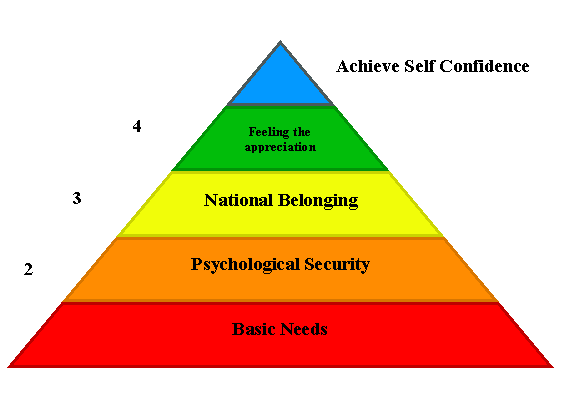
Fig.(1)Training pyramid
of human needs
Gender training, in specific terms, is an approach for changing the
attitude to gender oriented actions within organizations and institutions that
has become increasingly popular since the mid-1980s (Jongepier and Appel 1995).
Its origins lie in the development of popular education or
"conscientization" in
2. Training Techniques and Policy Formulation:
ï؟½ï؟½ï؟½ï؟½ï؟½ï؟½ï؟½ï؟½ï؟½ Before discussing the
needs for gender training at all levels, it may be useful to introduce the main
concepts of training techniques to lay a platform for the appropriate
mechanisms and efficient policy for gender empowerment and participation.
*The types of
training are summarized as follows:
ï؟½
Basic training
The training objective is to qualify the trainees with
the necessary knowledge and skills. Basic training does not require previous
working experience, but it does require the desire and motivation of the
community services trainees for the type of job they will perform.
ï؟½
Orientation or induction training
It is mainly general awareness about the overall goals
and objectives of the gender issues, the teamwork procedures, the institutional
and regulationsï؟½ etc. This information will enable the trainee to appreciate
his job duties and responsibilities within the scope of the community service organization.
It is always short time periods depending on the amount of knowledge and
information provided in order to fulfill the training objectives.
ï؟½
Refresher training
This training refreshes the trainee background, and
upgrade his/her knowledge and skills by introducing new technologies relevant
to the job. Thus, refresher training stimulates the capabilities of the working
group to be creative, more efficient and self-confident. It is usually
conducted before adopting new techniques and tools which aim to upgrade
performance.
ï؟½
Retraining
This type of training provides the trainee with new
knowledge and skills to perform a new community services job that is different
from his/her own, providing the new job complies with the background
experience. It is important to adjust the balance between the different skills
needed in order to avoid unbalance between jobs.
ï؟½
Development training
Training programmes are job promotion oriented, i.e. offered
to the trainees who will be transferred to senior community development jobs. This
higher level requires special knowledge, skills and administrative profession.
ï؟½ï؟½ï؟½ï؟½ï؟½ï؟½ï؟½ï؟½ï؟½ Gender training policy
formulation involves top management, planners, politicians and decision makers to
address several important elements, so it may be fully informed by and relate
to the specific context of the work and live. The training policy acknowledges
the three distinctive demographic gender groups, a) urban gender at the top
managerialï؟½ level b)urban and rural
gender government and nonï؟½government employees c)illiterate rural gender
sector.
ï؟½ï؟½ï؟½ï؟½ï؟½ï؟½ï؟½ï؟½ï؟½ The position or the
hierarchal structure form, in both local and urban contexts, to some extent
understanding difficulties to ï؟½gender
concerns and gender analysis; but it also dictates how much change they are
able to bring about.
3. Elements of Policy Formulation:
ï؟½ï؟½ï؟½ï؟½ï؟½ï؟½ï؟½ï؟½ï؟½ Gender training, at a small
scale, has achieved very positive results with many development planners and
hence projects' decision makers are becoming comfortable with the terms,
concepts of gender concerns and analysis.
Accordingly, Gender training is derived into several elements: Trainers,
trainees, approaches, frameworks, materials, difficulties and resistance. There
should also be continuous monitoring and evaluation against specific
indicators. The following guiding questions help to shade a light and reveal
ambiguities:
a)-Who Train?: Trainers to be chosen and co-trainers at the field levels
to form a link and based on the needs to build a core group of staff who are
confident in taking forward the process with other staff and counterparts. The
trainers should be representative of both the local context and the
organizations.ï؟½ They should have
considerable authority within the hierarchical system to ensure that the
importance of gender concerns is fully recognized by the trainees; also they
should be of high personal and professional caliber, ensuring that concepts and
tools are understood and used by participants. Trainers should monitor and
support the implementation of work addressing gender inequalities after accomplishing
the training.
b)_Who are the trainees?: Implementers, politicians, decision makers are
the intersection of an enormously complex set of social relations, within which
they operate and have influence both as individuals and as development
professionals. Training in context must acknowledge and addressï؟½ the hierarchical position of the trainees
within their cultural and organizational contexts.
C)-Approaches: "Gender is a political issue, because it is about
power. It is a political issue because it seeks to bring the private sphere into
the public arena of debate and action. MacDonald:1993.
C-1)The skills
acquisition approach is non-confrontational and non-threatening. This approach
is the best used in heterogeneous groups, and it is often used in short one-off
trainings. This approach is appropriate in giving trainees very important skills,
but it does not allow for time and space to address the more personal elements
of gender relations, nor the reality of gender relations as relationships of
power.
C-2)The personnel
awareness raising approach addresses peoples' attitudes, perceptions and
beliefs. This is a longer time and requires sensitive facilitation; it is also
best achieved with a homogenous group. It does not explicitly explore the
political nature of gender relations as relationships of power. Challenges power
relations is a political approach to gender. This can be threatening and
confrontational, creating increased resistance to gender concerns. However, if handled
sensitively, it equips the trainees with an understanding that fully addresses
the realities of gender relations, their basis in people and the relationships
of power that exists between people in both the local and the organizational
contexts.
ï؟½d)-How do people learn? The
principle is that adults learn best by actively engaged in subject-matter through
all over their senses and team work spirit. With some exceptions, the lack of
clear documentation in much of the gender training is a limiting factor in its
success in building the capacity. The over-reliance on the frameworks being
taught can lead to problems of over-simplification of gender issues, and the
failure to adequately address the complex reality of gender relations in
development initiatives.
e)-Training materials: It is important to use useful materials
effectively. Case studies help relate gender issues more closely to the local
context. Materials should contain references to the organization itself,
setting out how its policies and practice reflect its commitment to addressing
gender inequalities. Materials to be produced from the gender training
documenting its development and its success or failure in different contexts.
The lack of systematized documentation constrains the process of learning that
should be an integral part of gender training.
f)-Resistance: Many trainees find concepts of gender analysis threatening
personally and professionally, in other terms it is threatening the position
they occupy in a community. This leads to emotional resistance to gender
training and a failure to understand or implement concepts of gender analysis.
Language problems form a difficulty for the trainees to understand concepts
involved in gender analysis. Logistical difficulties also have different
implications for women and men, and should be given attention in the planning
of gender training course.
4. Gender Training Needs Assessment (GTNA) and Implementation:
There are Questions to be addressed and discussed before
preparing gender training:
1-What are the objectives of different training
programmes? Who devised them, and who is being served?
2-Who are the target groups and what assumptions are
being made about them?
3-What are the methodological bases and contents of
training programmes?
4-What type of background do training facilitators have
and do they tend to be women or also men?
5-What institutional training strategies are employed?
6-How is training institutionalized within an
institution?
7-Is gender training carried out by one sector(NGOs,
ministries and other institutions)or more sectors, if so, Why?
8-How is evaluation of training procedures undertaken;
and who benefits from the intervention?
9-How often is "follow-up" undertaken ? is it
effective?
ï؟½ï؟½ï؟½ï؟½ï؟½ï؟½ï؟½ï؟½ï؟½ Having defined the
detailed and clear answers to the addressed questions, one have to present
schematic sketches indicating the integrated conceptual representation to the
actions, Fig(2), illustrate the gender hierarchal training strategy matching
the individual needs with the organization requirement. Three levels of
training are identified level 1 is designed to train gender specialistsï؟½ directly in contact with the bottom
demographic group of the community whoï؟½
are completely ignorant about gender issues.

Fig.(2)Gender Hierarchal Training for Individual
Needs and
Organizations Requirement
The
three main pillars which gender training programmers aim to achieve ;
a-
provide
suitable education background to build on the knowledge and skills
b-
develop
self confidence to strengthen personality , change attitudes and create
commitments
c-
Stimulate
the ability to express technically and freely their needs (common technical
gender language )
Their
role is mainly to disseminate gender awareness and convince the broad-spectrum population
base of the importance and benefits of changing bad habits and attitudes
towards women in the community. Field visits are essential to survey and study
prevailing social norms, and environment to suggest action strategy and tools,
which gender specialists can use effectively and efficiently. Level 2 of
training is a step upward, aiming at addressing the relatively large working
gender spectrum who lack appropriate knowledge and information about equity and
ethical right to participate in planning and management of their concerned
organizations. At this training level, gender experts have more in depth role
of training exposure to legal and institutional aspects that might inhibit full
gender involvement in the development process. Hence, the training tools and
techniques are more advanced and technical. Level 3 concerns the ï؟½management of gender group, who are in charge
of polices and plans of projects which gender might not be having ï؟½equal chances and opportunities in the plans.
The gender-training professionals addressing this group must organize
workshops, bilateral meetings, round table discussionsï؟½etc, so, as to convey
messages and new concepts softly and clearly. For each level there is certain
different evaluation means to ensure the effectiveness and validation of the
overall training course with quantitative and qualitative indicators. The
common foundation of the different training levels are three basic pillars required
to achieve;
ï؟½
a) Suitable education background
ï؟½
b) build self confidence, and
ï؟½
c) use of common gender language for communication.
The second major activity for developing the gender
training policy is the determination of the gender training needs assessment (GTNA)
Fig(3).

Fig.(3) Determination of Gender Training Needs
ï؟½In fact, this essential
step is the core and essence of structuring the pre defined training levels.
The sequential GTNA process begins by identifying the gender plans and polices then
break it down into gender activities, organization structure, and work duties.
These information leads to identification of the required skills to implement
the plans and polices. However, a detailed survey is needed to determine the
existing skills and consequently the differences can be interpreted into
training needs and requirements which in turn can be categorized into the three
training levels. Hence, for each level certain amounts of knowledge, skills and
attitudes can be determined to achieve, the objective guiding; the design of
the training programmes, tools and techniques, and finally the evaluation
mechanisms. The overall training procedure has to be reviewed according to the
evaluation results of the three levels. Accordingly revised training policy can
be made to optimize the overall efficiency of the programmes addressing the
common needs of the targeted groups, indicated by Fig.(4).

Fig(4) Interaction Between Training Programmes
Conclusions and Recommendations:
ï؟½
Gender concepts and related issues are relatively new subjects
in the under developed countries. It needs drastic change in human behavior and
attitudes in order to accept women in developments at all stages.
ï؟½
The typical women categorized structure in most
thirdï؟½ world countries is characterized
by wide differences of three distinctive levels. The top level, a few
intellectual women at the policy and decision making, middle sector a
considerable number of half educated employees and bottom level, the bulk , are
illiterate, uneducated and dependent women.
ï؟½
Due to culture, inherited tradition, wrong religious
understanding, ignorance and other socio-economic factors, gender ideas are not
accepted by the society. This fact inhibits the progress of developments nation
wide, which turn planners and decision makers, in some countries, to listen to
donors and international gender experts to the importance of gender involvement
and participation in the development process.
ï؟½
A few experiences for introducing gender concepts, show
strong resistances and objections to change prevailing habits, attitudes and
bad traditions. However, most donorsï؟½ projects include gender components to
carry out the analysis and studies to overcome this problem.
ï؟½
Some simple and modest efforts have already started in
several countries, particularly in ï؟½MENAï؟½ with the help of developed
Mediterranean countries, such as
ï؟½
Therefore it is highly recommended that special gender
training programmes should be developed based on the regional needs in the
field of water management now and in future. Training courses should be
tailored to the specific needs of the targeted group, such as water management,
through modular training programmes. A set of courses to be designed with gradual
information and full set of needed knowledge to reflect the need for skills
acquisition.
ï؟½
Gender training for implementers, politicians and
decision makers should be continuous: it is an important contribution to
building the capacity of staff to work on gender issues.
ï؟½
ï؟½ï؟½Trainers to be
selected as trainees for gender training should be positioned within local and
organizational hierarchies in ways that represent real opportunities to carry
out gender- aware work. ï؟½Time and
resources should be available for trainers to carry out needs assessment before
gender training implementation. It is essential to train the trainers on how to
conduct needs assessments and institutional analysis to gain an understanding
of the trainees hierarchical location to prepare training that acknowledges
both the opportunities and the limitations to address gender inequalities.
ï؟½
New, imaginative approaches to educate gender analysis techniques
should be developed and shared. In addition, provision of long-term, local
support in applying skills in gender analysis should be an essential component
of gender training. Strong institutional support is a pre-requisite for the
long-term success of any follow-up activity.
ï؟½
Evaluation of gender training is generally carried out
at the end of a course, and so will evaluate the course itself, the performance
of the trainer, the tools and facilities used.
ï؟½
Finally, it is strongly recommended that Bari institute
should take the lead to initiate the innovative step by establishing, ï؟½Bari
Gender Training Centerï؟½ for the purpose of unifying concepts and standardizing approaches,
disseminating in MENA and the Mediterranean region some stories of genderï؟½ success and lessons learned, and combining
multinational experiences of gender coordinators to share and implement
training courses based on real field experiences from the region. Indeed by
this land mark, Bari institute will not only be strongly supporting the
countries of the region but also will create unique example of gender training
activity that can be copied worldwide under similar conditions.
ï؟½
Finally yet importantly, I would urge to issue a new
journal/magazine/newsletter or else for the regional gender activities such as;
regional gender occasions, gender articles case study results, training offered
and other activities. Again,
Support Documents:
-Gender Training for Development Policy Implementers, An
Oxfam Working Paper, Fenella Porter and Ines Smyth.
-Appropriate Training for Professional
Development and Improved Performance, Fouad El Shibini MB. Saad,
-Training of Trainers Course
documents, held in Beirut by the Center for Research and Training on
Development (CRTD)- Machreq/Maghreb Gender Linking and Information Project.
-
Integrating Gender in Water Management Projects